
Get an ITEL Test Before You Repair Your Roof
You had some wind come through. A few shingles are missing — maybe one, maybe four. It's not a catastrophe, and the instinct is to call a roofer, pay a few hundred dollars out of pocket, and move on with your life.
Before you do that, spend about $200 on a lab test.
That sounds like strange advice for a small repair. Here's why it isn't: in a lot of states, including Kentucky and Ohio, the answer that test comes back with determines whether you're looking at a four-shingle patch or a full roof replacement paid for by your insurance carrier. And once the repair is done, you've lost the ability to ask the question.
What this looks like in practice
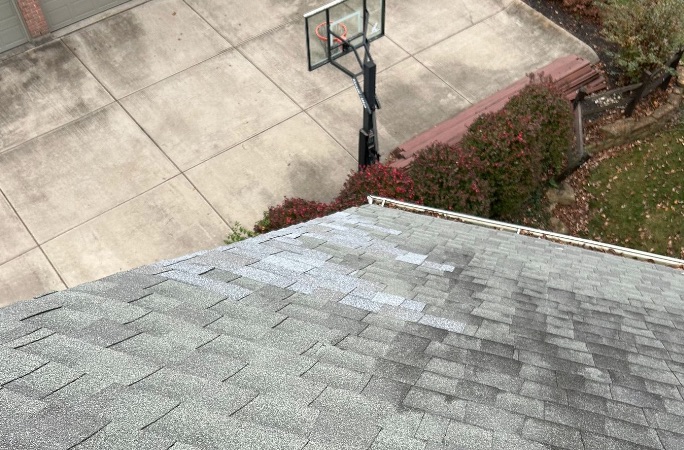
That's a real roof. The homeowner had minor damage — below his deductible, so filing a claim looked pointless. He paid about $500 out of pocket for a patch, and the roofer used shingles that were close but not the same.
You can see the result. The patch reads as a bright rectangle against the weathered field around it.
Later, a storm brought a claim on that same roof. The carrier approved it for repairs only. When we pulled a sample and sent it to ITEL to source matching material for those repairs, the report came back: discontinued.
Under Kentucky's matching rules, a discontinued shingle with no available match means the whole roof gets replaced. That report should have turned a repair-only settlement into a full replacement.
It didn't — because the roof was already mismatched. He'd patched it himself years earlier, so the argument that the carrier owed him a uniform roof no longer held. That $500 patch cost him a roughly $20,000 roof.
Here's the part worth sitting with: the damage that started all this was below his deductible. Filing a claim on it genuinely wasn't worth it, and he was right about that. But an ITEL test would have told him his shingle was already discontinued — and a discontinued shingle turns a below-deductible repair into a full replacement claim. The economics flip entirely, and the only way to know is to test before you touch the roof.
What an ITEL report actually is
ITEL Laboratories is an independent testing lab — now owned by Nearmap — that identifies building materials from a physical sample. For roofing, you or your contractor pull a shingle off your roof and send it in. The lab analyzes it and comes back with the manufacturer, the product line, and the specific color.
Then it answers the question that matters: is that shingle still available on the market today?
Insurance carriers have relied on this lab for decades, which is exactly why the report carries weight. It isn't your contractor's opinion against the adjuster's opinion. It's third-party data both sides already accept.
Turnaround is typically somewhere in the range of a week to ten days.
Why the timing is the whole point
Most homeowners hear about ITEL after a claim is already in dispute — the adjuster approved a spot repair, the homeowner thinks the roof needs replacing, and somebody orders a test to break the tie.
Getting it done first flips that. You walk into the conversation already knowing the answer, and you haven't yet destroyed the evidence by patching the roof.
There are only two outcomes, and both are useful.
Outcome one: your shingle is still available
Good news, and simpler than you'd think. Buy the matching product, do the repair, and keep the ITEL report with your records.
Then send a copy to your carrier and ask them to note it in your file.
That last step is the one people skip, and it protects you twice. First, it documents that your roof is uniform — so if you file a larger claim in three years, nobody can argue your roof was already mismatched before the storm. Second, if your policy carries a matching endorsement, you've established a clean baseline for what "matching" means on your house.
Worth knowing: if the same shingle is still in production, Kentucky's Department of Insurance has said that using it satisfies the matching requirement even if your existing shingles have faded from years of sun. Age-related discoloration alone doesn't get you a new roof. That's a real limit, and any contractor telling you otherwise is overselling.
Outcome two: no match is available
This is where the $200 pays for itself many times over.
Most states have some version of a matching regulation, generally traceable to the NAIC model language: if replaced items don't reasonably match in quality, color, and size, the insurer must replace all items in the area to conform to a reasonably uniform appearance.
Kentucky's version is unusually strong. The regulation is in the state's Fair Claims Settlement Practices rules, and in a 2023 advisory opinion the Kentucky Department of Insurance spelled out how it reads:
- "Area" means the entire roof — not the damaged section, not one slope.
- Line-of-sight doesn't apply. Some states let insurers match only what's visible from a single vantage point. Kentucky explicitly rejected that approach.
- If matching shingles aren't available, the whole roof gets replaced. The Department's own example: if one slope has to be replaced and there's no shingle that would make that slope reasonably uniform with the rest, an entirely new roof must be installed.
Ohio has a comparable regulation on the books.
So if your ITEL report comes back with no available match, and you're under a replacement cost policy, you may be entitled to substantially more than a patch. That's the moment to file a claim — not after you've already paid a roofer to fix it.
One caveat worth knowing
"A match is available" isn't always the end of the story.
Nearmap maintains an inventory of discontinued shingles and can supply them for claims — which means a carrier can sometimes source a discontinued product and avoid a full replacement that matching rules would otherwise trigger.
If your report says a match exists, it's fair to ask where that product is coming from. A discontinued shingle pulled from warehouse stock raises reasonable questions about warranty coverage and whether the material will weather the same as what's already up there. You don't have to accept "we found some" as the final answer without asking what exactly is going on your roof.
When you can skip the test
There's one situation where you already have the answer: you've got leftover shingles from the original install, plus paperwork from that job showing the manufacturer and color.
That's the same thing an ITEL report would tell you, sourced better — the material is literally off the same order. Do the repair, keep the invoice and the product documentation with your records, and you're covered.
Expect the patch to look lighter at first. A bundle that's been sitting in the garage hasn't weathered like the roof has. That's fine — Kentucky's Department of Insurance has been explicit that using the same shingle satisfies the matching requirement even when the existing roof has faded with age. Same product is same product. It'll blend as it weathers.
The only reason to test anyway: if you're unsure the leftover bundle actually came from your roof, or the paperwork is missing. A garage full of unlabeled shingles from a previous owner isn't documentation.
What to do
- Check the garage first. Leftover shingles plus the original install paperwork means you already have your answer.
- Otherwise, don't repair yet. Once the damaged shingles are off and new ones are on, your leverage is gone.
- Get a sample to ITEL. Most roofing contractors can handle the submission. Expect roughly $200 and about a week.
- Read your policy. Look for replacement cost coverage and any matching endorsement, and note your deductible.
- Look up your state's matching regulation. Kentucky and Ohio both have one. Your state's Department of Insurance site is the place to check.
- Then decide — repair and document, or file a claim.
Four missing shingles feels too small to make a fuss about. That's precisely what makes it worth a phone call before the ladder goes up.